Blog

30-Year Fixed-Rate Back Below 4%

The 30-year fixed-rate mortgage moved below 4 percent this week as economic indicators point to housing weakness and a lag in the economy recovery, according to Freddie Mac’s Primary Mortgage Market Survey. “The S&P/Case Shiller 20-City Composite home price index slid in January to its lowest reading since December 2002,” said Frank Nothaft, VP and chief economist for Freddie Mac.

Last week, the 30-year fixed-rate averaged 4.08 percent, above 4 percent for the first time since October 2011. This week ending March 29, the 30-year averaged 3.99 percent (0.7 point).. The 30-year is still below last year’s average at this time, when it was 4.86 percent.

Spending Outpaces Income, Savings Rate Declines

The Bureau of Economic Analysis (BEA) reported that consumer spending grew 0.8% in February, increasing expectations for a stronger first-quarter.  On the other hand, personal income grew just 0.2%.  This is just half the rate expected by economists. Of the nation's gross domestic product, consumer spending represents about 70.6 percent.

As a percentage of disposable (after tax) income, personal savings fell to 3.7 percent in February from 4.3 percent in January.

The increase in spending was evenly divided between goods and on services, but most of the increase in spending on goods came in the “non-durable” category, hinting at a lingering unwillingness by consumers to make purchase which require borrowing.

The Personal Consumption Expenditure (PCE) Price Index – often considered the Federal Reserve’s favored measure of inflation – increased 0.3 percent and is now 2.3 percent above its year ago level.  Core consumer inflation has been rising for the past 12 months.

Housing market slowly being nursed back to health

Yesterday’s housing numbers came in a little lower than expected, but overall the year 2012 is looking good as building permits jumped to its highest level since October 2008.Permits for multi-family units are much higher than single-family units, possibly reflecting the rise in investor activity in the housing market. Data on the sales of existing home sales for January and February also came out today, showing its highest level since 2007.

The Daily Ticker (Yahoo! Finance) argues that, even though things will some day improve, any recovery efforts in housing may be short-lived:

  1. Home prices are still high base on historic and fair value numbers
  2. A recovery should be suffocated should any shadow inventory come up on the market, while short sales can depress prices in the immediate area
  3. Unemployment is still high and many homeowners are underwater
  4. Rising Treasury yields, a result of the improving economy, can cut into housing affordability
  5. A mild winter and the Fed’s aggressive involvement has artificially boosted the housing strength only temporarily.

The problem with today’s market is also a lack of inventory, and it’s possible homeowners are holding off on selling until home prices stabilize.

Rent prices on the rise as home values decline, according to Zillow

Zillow_graph_0315b

Zillow_graph_0315b

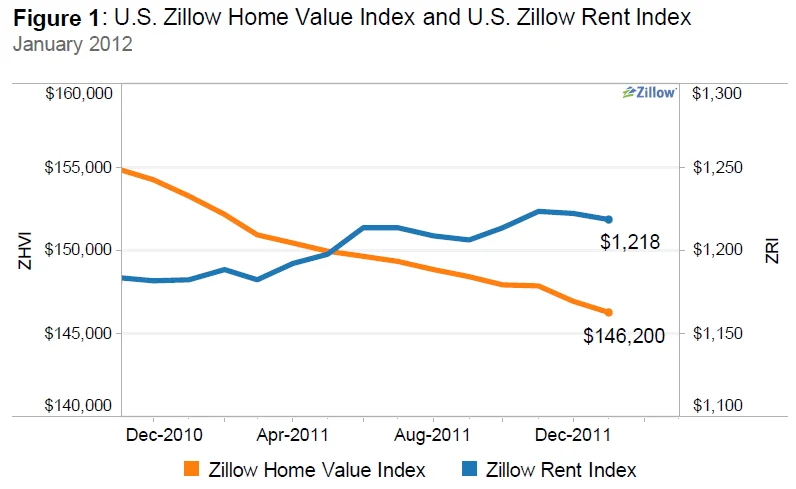
Proving that more people are renting rather than going into homeownership, Zillow reports that rent prices went up 3% in 2011, while home values dropped 4.6%.

“While it seems that rents are rising at the expense of home values, the opposite is true. A thriving rental market will stimulate home sales as investors snap up low-priced inventory to convert to rentals,” said chief economist for Zillow Dr. Stan Humphries in a release (via DSNews.com).

This could have something to do with the government's Real-Estate Owned (REO) pilot program, launched in August 2011, which put nearly 2,500 foreclosures up for sale in February 2012 to pre-qualified investors. The investors would then convert the properties into rental units, thus hopefully stabilizing neighborhoods and reducing the number of foreclosures on the market. Nearly all of those foreclosed homes that are part of the pilot program are located in Los Angeles.

With the Zillow Rent Index, we are now able to quantify exactly how the rental market is growing across the country.

Democrats call for principle reduction to help underwater homeowners

It's not an uncommon story since the real estate market took a tumble a few years ago: A homeowner, on their second mortgage, owing a lot more than the house is actually worth. Unfortunately, over 11 million residential properties in the US are having the same problem - they are "underwater." The extreme loss of equity affecting homeowners and their loan to value ratio has some calling for the government to take action and reduce the number of underwater homes. For some, a short sale is a good option - but it's not for everyone.

Lawmakers are now calling for giants Fannie Mae and Freddi Mac, which owns or guarantees 56% of all US mortgages, to reduce the amount underwater borrowers owe, a process called principle reduction.

The idea is that principle reduction would help by giving borrowers more money overall, making it easier to sell their home (not through a short sale or foreclosure), and have the freedom to move closer to work and other job opportunities. This could then help drive economic activity, reduce unemployment, and help the overall housing market.

Some disagree that the government should step in and help underwater homeowners - citing bad decision-making in buying a home they couldn't afford in the first place. Ed DeMarco, acting director of the Federal Housing Finance Agency, says it would cost taxpayers $100 billion, adding that solving unemployment issues is not a responsibility of the FHFA.

Regardless of whether or not the government should help and how, the reality is that millions of homeowners are still at risk of foreclosure.

Read more about it from MarketWatch.

Highland Park becoming a hub for house flippers

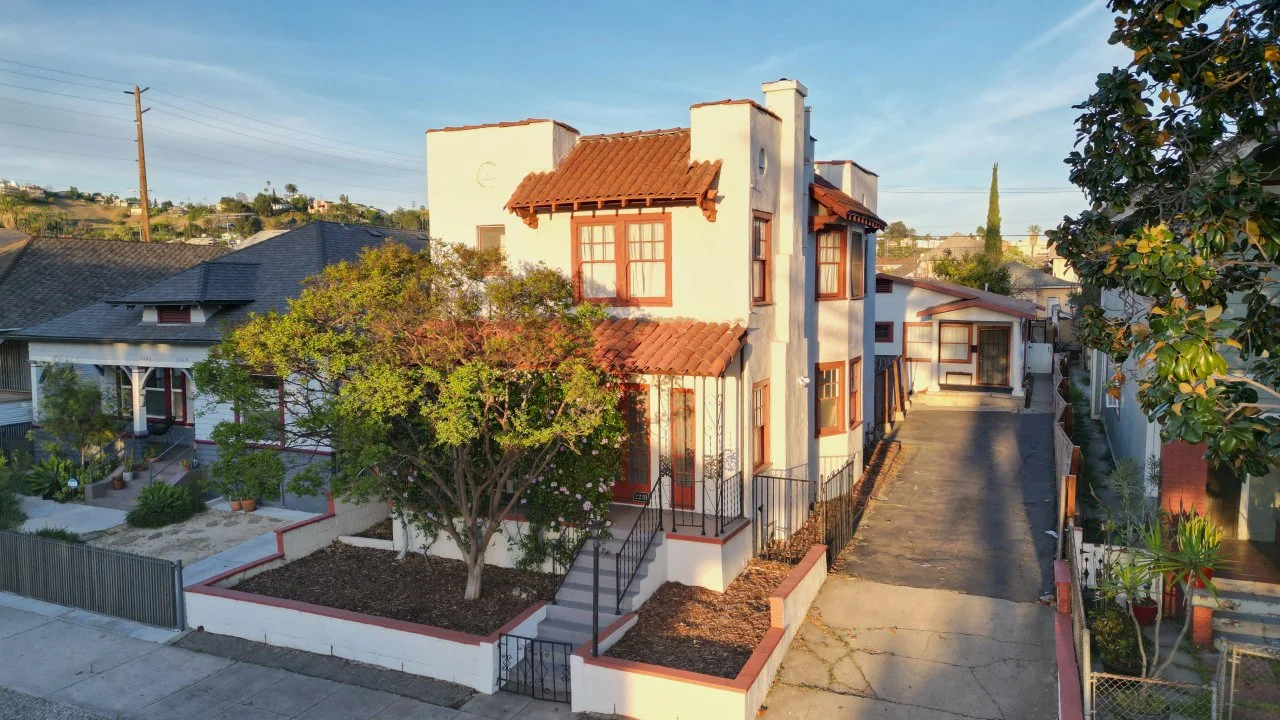
Highland Park is getting a lot more attention from flippers these days. Attracted by the large number of foreclosures and low prices, investors are turning less to pricier communities like Echo Park and Silver Lake, and more toward areas like Highland Park in Los Angeles for a good deal. Highland Park is experiencing a second wave in the housing boom, or what some would call a “gentrification” – the working class and low-income population of the neighborhood are moving on. In the first wave during the housing boom it was a choice to sell and reap the rewards. This time around it's not by choice, and is often due to foreclosure. Similar to the first time around, what has come are cool, hipster storefronts and residents.

The flipped homes in these communities are more affordable than the nearby neighborhoods, and the inventory is good. LA Weekly dubbed Highland Park the place to go “for those who are ‘over Echo Park.”

The LA Times, citing data from DataQuick, indicated 29.1% of the homes sold in Highland Park in recent months are absentee buyers, outnumbering nearby areas like Eagle Rock and Glassell Park. January saw two in five homes sold were bought by investors.

The median prices of Highland Park homes, according to city-data.com, median prices are staying pretty low at around $260,000. The great thing about Northeast Los Angeles housing inventory is that its diverse in property size, type, age, amenities and neighborhoods. Although there has been price increases in the last 10 years there is still a lot of opportunity for upside in the right location and type of property. This is why there is still so much interest in investing in Northeast Los Angeles even in a down market.

90042

90042

Whether or not you’re a flipper, an investor, a first time home buyer, Highland Park might be the right place for you. There’s an up-and-coming commercial strip along York Avenue with desirable restaurants, bars, and shop. Add in access to bike paths, the metro, and even plenty of parking, it’s definitely a attractive community in Northeast Los Angeles.

Why short sales are outnumbering REOs

foreclosure

foreclosure

RealtyTrac reports that in the fourth quarter of 2011, the sale of foreclosed homes accounted for 24% of sales. Even though sales are up from 20% the year before, sales are still sluggish due to reluctance surrounding foreclosure paperwork and procedures, says RealtyTrac. Despite the slow sales of foreclosures at the end of 2011, the forecast for 2012 looks good. Less constraint with mortgage lending procedures means lenders will be able to start selling off inventory. Short sales, however, are becoming the trend for banks as they are faster and more profitable for everyone. In fact, short sales exceed 20% of all home sales in Los Angeles, outnumbering REOs. Read more about the numbers on Cnn.com.

Interested in learning more about the short sale process and how it could benefit you? Contact us today!