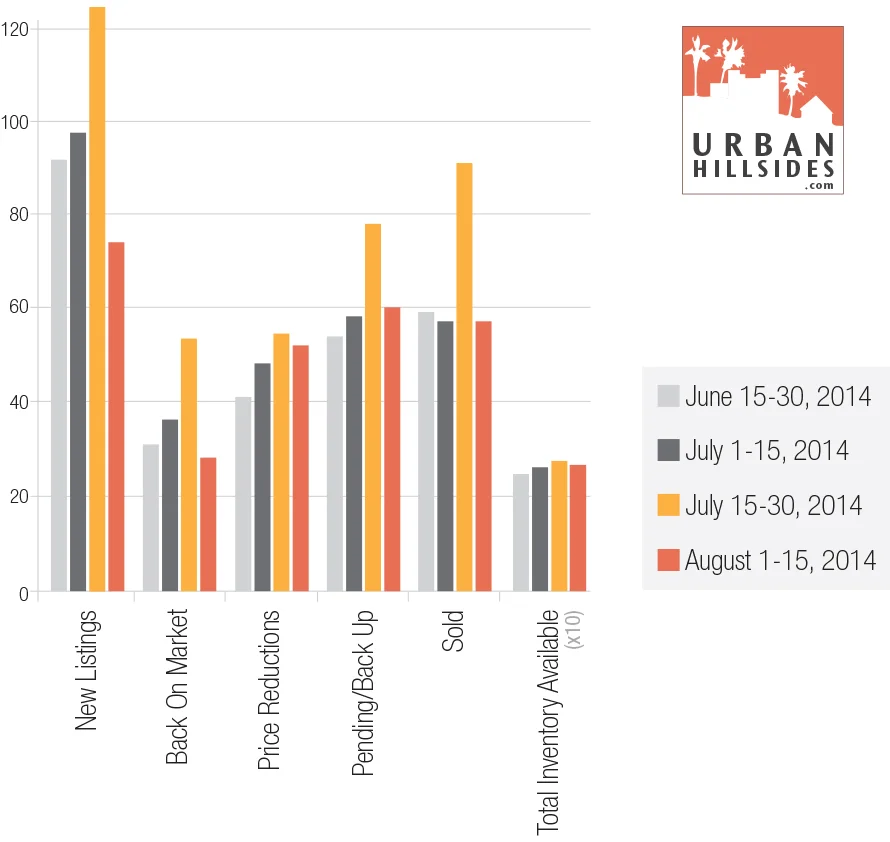
Market Report: New listings, sold properties, price reductions and more for Northeast Los Angeles (Echo Park, Silver Lake, Los Feliz and more!)

Los Feliz
Rancho Los Feliz was originally given to Senor Vicente Feliz, a Spanish army corporal who accompanied the original 44 settlers to what was then known as “El Pueblo de la Reina de Nuestra Senora de Los Angeles.” He was given grazing rights to raise cattle here in exchange for his excellent service to the Spanish Crown. Five miles northwest of downtown, it is now known for its Spanish style estates that line the southern hills of Griffith Park with spectacular city views. It is also home to some of the grandest residential architecture in the city, including two homes designed by Frank Lloyd Wright: Hollyhock House and the Ennis House. John Marshall High School in the Los Feliz district is one of the most highly recognized high schools in the city. The school is known for the achievements of its magnet program in the academic decathlon and the main building is a historic landmark. Griffith Park in Los Feliz, offers a wide range of entertainment options with the Greek Theatre, Observatory, Museum of the American West, LA Zoo, 3 golf courses, hiking and horse riding trails. Los Feliz is centrally located yet uniquely situated in a part of the city that is vibrant and exciting. Bordered by the star studded Hollywood area, Los Feliz offers great nightlife and legendary restaurants, just south of the boulevard.

Eagle Rock
Eagle Rock and Mt. Washington are both hillside communities each with their own unique flare. Mt. Washington’s hilly geography creates a rural retreat that contrasts with the cities otherwise urban landscape. This community has plenty of undeveloped land and cabin like homes on large lots amongst the trees. Just 4 miles north of downtown, with no major boulevards running through it, the area has been able to retain a county like feel. A Metro Gold Line station serves the southeastern parts of the neighborhood that connects to Pasadena and downtown Los Angeles. There is a stop at the local Southwest Museum, whose collections deal mainly with Native American and Spanish Colonial history. Adjacent to Mt. Washington, just five miles from downtown Los Angeles you’ll find Eagle Rock. The name was adopted from a bird-like rock formation at the north-eastern most corner of the area. It is home to many architectural treasures of the Arts and Crafts movement. Hill Drive offers some of the city’s most beautiful and well maintained Craftsman homes. Eagle Rock has an eclectic feel with a combination of city dwellers and suburbanites. It is bordered by the cities of Glendale and Pasadena, adding a suburban atmosphere and then Highland Park and Glassell Park that maintain an edgy, city vibe. Occidental College, the Ivy League of the west, is at the southern edge of Eagle Rock, adding a unexpected collegian energy to the area.

Atwater Village
Although these areas are not technically hillside communities, they form the connections to the surrounding hillsides by way of geography and architectural merit. These neighborhoods are peppered with Spanish and Craftsman architectural gems. Most of the homes are smaller in size with much of their original character intact. The communities of Elysian Valley and Atwater are divided by the Los Angeles River. There is a river project underway that will unite the communities and create a destination spot for biking, walking and family based recreational outlets that will positively impact quality of life for residents. Elysian Valley has a commercial and arts district that follows the river’s path and will continue to expand as the river project is implemented. Atwater’s commercial district along Los Feliz Blvd., Glendale Blvd. and Fletcher has seen a recent expansion of eateries and quirky specialty shops.
Highland Park
Art and Architecture have flourished in the Highland Park neighborhood since its beginnings in the late 1880s. In 1885 Charles Lummis came to Highland Park and built his home, named “El Alisal,” along the Arroyo Seco. It took 15 years to build the concrete/stone craftsman residence whose name means “Place of the Sycamores.” The home is now a cultural monument and maintained by the Southern California Historical Society. A few decades after this primarily residential area was developed, its business district was established along Figueroa St. Like many other areas of Los Angeles the development in the 50’s and 60’s had an impact on the original architecture of the area. Much effort has gone into restoring the areas commercial and residential architecture. Heritage Square was started by local activists to save some of the Victorian homes that stood to fall victim to development. It has become a museum for the community to remember its history. There are large sprawling parks in the area, including the Arroyo Seco Park and the Ernest E. Debs Regional Park. Before the rise of Southern California housing prices from 2002–2005, many sought out property in Highland Park to own and revitalize Craftsman homes, some which had suffered neglect over the decades. Although this quiet movement continues, Highland Park has not undergone the dramatic changes that Echo Park and Eagle Rock have experienced. The district's proximity to those neighborhoods (coupled with low rents), have made it increasingly popular among "hipsters." Glassell Park and Cypress Park are blend of residential and commercial properties. They were developed along the Pacific Electric Railway and have a long industrial corridor along San Fernando Road, with a low rise commercial district on Eagle Rock Blvd. These neighborhoods have been significantly affected by the Southern California real estate boom that began in the early 2000s. An influx of middle-class families moved to these neighborhoods, attracted by the abundance of Craftsman homes and relatively low prices. Most current residents are working-class Latino, Caucasian, and Filipino families that benefit from easy commuter routes via three freeways (the 5, the 110, and the 2) and close proximity to Downtown Los Angeles and Hollywood.